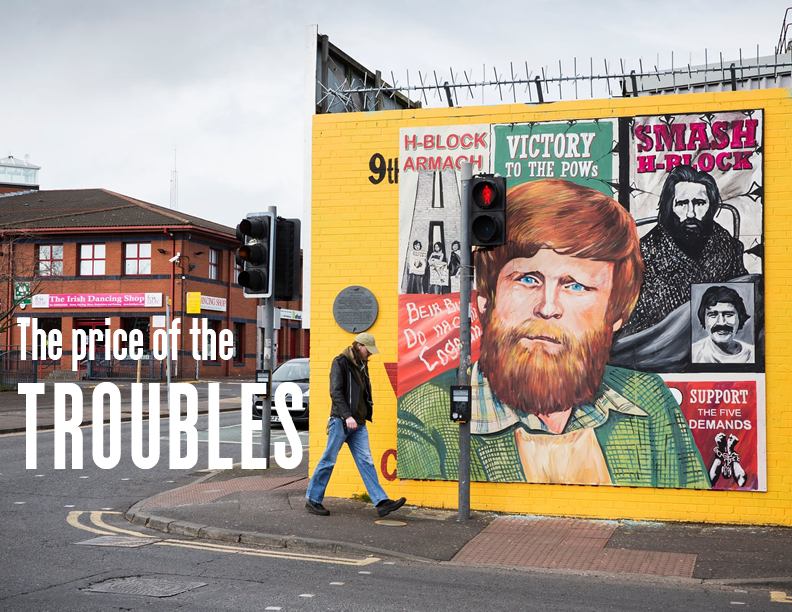
The Price of the Troubles is a multimedia project investigating the campaign to stop ex-paramilitaries receiving compensation as a result of a new agreement by Government.
Targetted for The Times Magazine, this print feature includes interviews from Shankill Road Bomb victims Michelle Willaimson, who left orphaned as a result of the bomb, and Alan McBride, who lost his wife and father in law in the explosion. Justifying the qualification requirements for the Troubles pension is lawyer Stuart McGee, who worked closely with Victims Commissioner Judith Thompson in producing the agreement.
Self-harm is something that is continuously rising among young people in the UK. In fact, according to a study published by the Lancet Psychiatry, 1 in 5 women in England aged 16-24 self-harm.
Around 50% of people that self-harm don’t access support, according to that same study, so it’s more important than ever that friends and family are there to offer comfort and support.
Seeing Beyond The Scars explores how we should support those who self-harm, and how we can improve our understanding of the issue to help us support effectively.
The following audio will discuss the sensitive issue of self-harming. If you feel you are unable to listen to such content, please refer to our website where you can find out who to go to for help. If you are in urgent need of support, call the Samaritans on 116 123.
For more about this documentary, visit the Seeing Beyond The Scars website.
Only 2% of the UK population are on the Stem Cell Register but with more than 2000 people in need of a transplant each year, it makes it more difficult to find a match with the lack of diversity on the register.
This documentary includes reflections from patients on how their lives were saved by a stem cell transplant, a donor’s experience and in depth knowledge from a charity working for diversity on the register.
For more information on this project, please visit my production blog and Twitter account.
Imagine you’re in a crowded tube carriage during rush hour, or fighting for standing room on a bus journey, or just passing the time in a coffee shop and your phone vibrates.
The reply you’ve been waiting for, an important email? No, it’s an unwanted, unpleasant, explicit image and you don’t know who it’s from.
No Flashing Matter looks at Cyber Flashing – What is it? What is it like? What is being done?
A radio documentary by Ellie Moore at Bournemouth University.
MUSIC AND SFX: Free sounds Purple Planet PMO.bournemouth
WARNING: This documentary contains graphic content that some listeners might find disturbing.
Cut the Misconception: Female genital mutilation, pregnancy and birth goes into detail about how survivors of FGM can go on to have children of their own.
In this documentary you will listen to an FGM survivor who has gone through four natural births.
This documentary features Alison Byrne, Laney Holland, and Saribaa (whose name has been changed for the purposes of this documentary).
A radio documentary exploring trauma in midwives. A Midwifes Trauma is comprehensive discussion about how midwives can become traumatised, the implications of having traumatised midwives working in the healthcare system and what can be done.
When we think about birth related trauma, we are often drawn to the high number of mothers developing PTSD after a traumatic labour. Should we also be thinking about the midwives?
A combination of studies have shown that 17-33% of midwives can develop PTSD as a direct result of work related trauma and the UK short of nearly 3000 full time midwives, is the emotional burden of the career becoming too much to carry?
During a lab test, scientists found what is known as a T-cell in people’s blood.
Georgina Barnes found out more – listen to her radio package below.
The discovery could potentially kill cancers such as breast, blood and skin cancer.
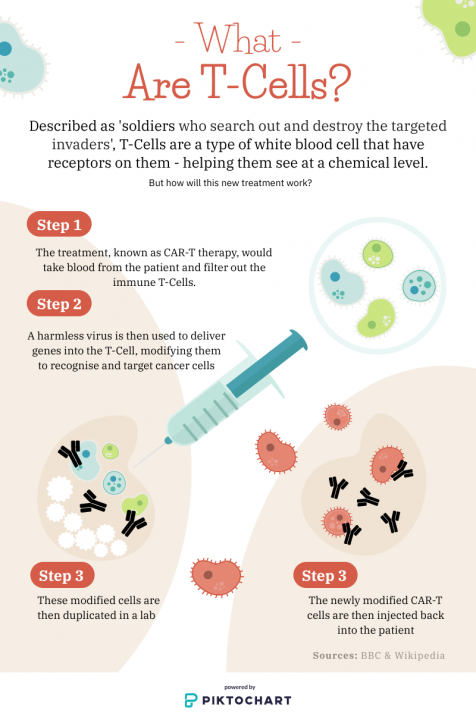
But what are T-Cells?
Infogram describing function of T-Cells and CAR-T Therapy. Credit: Georgina Barnes
Explaining the science behind this new discovery, Dr Tim Banks, Head of research at Tenovus Cancer Care, said this was “very exciting for research”.
He also talked about immunotherapy, saying: “It’s a lot kinder on the body.
“It only attacks those cancerous cells.
“Radiology basically burns off the cancer but it also those around it.
“All the time it’s getting better and better at targeting just those cancer cells, even though the area around it can get damaged.”
Listen to the full interview below.
Speaking to someone who has suffered from cancer, Ben Ainscough is a 20-year-old Bournemouth University student studying Sports Development and Coaching Sciences.
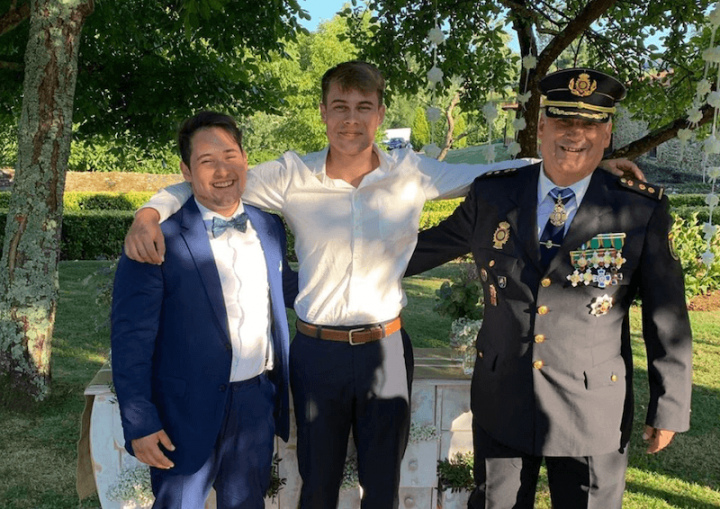
Ben Ainscough (middle) with his family. Credit: Ben Ainscough
When Ben was two-years-old, he was rushed to Great Ormand Street after doctor’s found he hadhepatoblastoma. This is an uncommon malignant liver cancer that can occur in infants, with a survival rate of 80%.
His form of cancer was so rare that fewer than one in a million children get it, describing his treatment as a “trial and error”.
Finishing chemotherapy and radiotherapy at five-years-old, Ben said that the scars knocked his self confidence:“I’ve got a few scars around my side and I’ve got a big scar around my front, and just little scars from where they had to inject me, where they had to cut me open, have my catheters and all of that.
“I’ve grown to appreciate them and know they’re the reason that I’m basically still alive.”
Speaking about his second battle with cancer, Ben developed familial (adenomatous) polyposis. These are polyps in the bowel that have the potential to turn cancerous later on in life. At 14-years-old, the doctor’s told him he’d have to undergo an operation to remove them:
“I was meant to have a key hole surgery, but because of the previous cancer they had to do it the old traditional way.
“So it took a lot more time and a few blood transfusions.
“It left me in a bit of a more worse way.
“I had to leave sixth form and collegebecause I had to basically start to learn to walk again.”
After finding out about this new potential method of curing cancer, Ben thought that “any discoveries’ great, and this one especially, because it’s relatively natural.
“Don’t get me wrong, chemotherapy and radiotherapy, they’re all brilliant, but they do have massive side effects.
“Your body’s so smart it’s going to eliminate the cancerous cells and all of that so that is pretty crazy.
“My parents wouldn’t have (had) to spend hundreds of nights in a hospital being worried about me, and I think it would stop so many deaths and stop so many worries.
“It’s great that we’ve got this but we’ve still got to keep on top of it, check yourself and all of that for bumps and lumps.”
Listen to the full interview below.
Although the potential of this treatment being put into play, scientists and the public of Bournemouth are hopeful about this new discovery.
For the past two years, Fortnite has dominated the gaming world.
Children across the UK have become obsessed and, with the release of a brand new map, parents must be wondering when its rapid rise will come to an end.
This documentary delves into the psychology behind why young gamers have become captivated by this immersive game, and the impact it is having on the lives of those who play it.
The Fertility Network UK and IVF Fairness are joining forces to campaign for an end to Britain’s IVF postcode lottery.
Dr Emily Scott from IVF Fairness said: “It’s a health equality issue and I hope that working alongside the Fertility Network and other lobbying organisations we can make a real change”.
The IVF postcode lottery refers to the current state of affairs in which clinical commissioning groups (CCGs) have sovereignty over what fertility services they will offer, who they are offered to and how many rounds each person is allowed.
In England, not only does your postcode determine your access to IVF but there is also a strict access criteria that can be a minefield for many couples hoping to start a family.
Spokesperson for the Fertility Network, Natalie Aminoff said: “We need to look at CCG’s because they are the ones who make the decision about funding and it can really impact someone’s whole life and their mental health.”
The postcode lottery has created huge inequalities up and down the country. There are vast differences between the services available from one CCG to the next.
In June – amidst huge backlash after the temporary suspension of fertility treatments in 2017 – the Cambridgeshire and Peterborough CCG decided to withdraw all NHS-funded fertility services.
The National Institute for Health and Care Excellence (NICE) guidelines recommend couples have access to three rounds of IVF, however the latest figures show 80% of CCGs do not currently offer this.
Former Junior Minister in the Department of Health, MP Jackie Doyle Price has said that the current system and postcode lottery “blights patients lives and damages the reputation of the NHS”.
During her time in the department for health Ms Doyle Price had “tried to ensure all CCGs offered at least one cycle of IVF.”
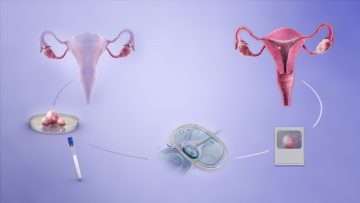
The process of the IVF cycle – Image labelled for reuse – Wikimedia Commons
Figures obtained by one campaign group, Fertility Fairness, show that there are in fact seven CCGs that offer no NHS-funded fertility services at all.
CCGs were established as part of the Health and Social Care Act in 2012. They are groups of general practices in each area that commission services for their patients.
Since their creation, CCGs have faced criticism over their spending. The latest figures from the National Audit Office on the Financial sustainability of the NHS show that 32 out of 209 CCGs are facing a cumulative deficit and as a result are having to cut services.
General Practitioner, Dr Ruth Coleman said: “Unless we are willing to dig deeper into our pockets as tax-payers, then we really must start asking some difficult questions about what the NHS is for.
If we can’t afford to do everything then unfortunately fertility treatment is too close to the line and is the first thing that goes.
However, Dr Scott has argued that the World Health Organisation defines infertility as a disease and therefore the NHS should “treat it like one”.
Personal experience
Inspired by her own experience Dr Scott decided to start the petition to end the unfair and unequal access to IVF.
Unable to naturally conceive Dr Scott and her husband were advised by their GP to try IVF, being told they had access to three rounds on the NHS.
However, after three unsuccessful cycles and nearly one year later, they received an invoice in the post from the IVF clinic demanding £1,995 to be paid as soon as possible.
Dr Scott explained: “Before we started the treatment and the whole way through, we made sure that we were covered by the NHS for the treatment.”
Later, Dr Scott discovered that the Oxfordshire CCG policy that is shared with the Thames Valley area in which she falls under, offers only one round of IVF per couple.
In their summary of rationale for departing from NICE guidelines, a 2013 document released by the Thames Valley CCG states that the recommended assisted reproduction services would be “unaffordable”.
Having IVF can be a very difficult treatment with a gruelling six stage process to harvest a woman’s eggs. During in vitro fertilisation (IVF), an egg is removed from a woman’s ovaries and fertilised with sperm in a laboratory. Once fertilised, the embryo is placed in the woman’s womb to develop.
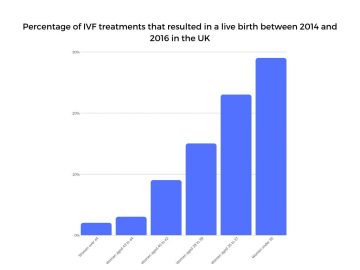
There is less than a 30% chance that IVF treatment will be successful for women aged 35 and under with success rates decreasing significantly with age.
Percentage of live IVF births. Created by Nicole Baddeley – Canva
Scotland are currently leading the way in the UK for progressive fertility access for all, with three cycles of IVF per couple.
In England issues with the current access guidelines include secondary infertility (whereby you are unable to conceive a second child) not being acknowledged, as well as your age being a major factor in whether or not you are deemed eligible.
With the purse strings of the NHS tightening, Dr Coleman said: “You can only work with what you’ve got so you have to work with the system that your CCG has given you.
“I think if we wanted to be fair there is an argument that says no fertility treatment should be offered on the NHS.
We’re up against comparing it with ever more expensive drugs for cancer and that sort of thing and I think women are fortunate to get it for free at all.
In the UK more than 250,000 babies have been born through IVF since the birth of Louise Brown, the first IVF baby in 1978. Since then IVF success rates have improved but with CCGs continuing to deny fair and equal access to fertility treatment. This means that people across the country are being left to face the emotional, social and financial hurdles alone.
The future of the IVF postcode lottery
After the calling of the snap election on the 29th October, the IVF Fairness petition pushed to reach 100,000 signatures to ensure the issue of equal access to IVF would be discussed in the new parliament.
By the 6th November the petition reached 10,682 signatures and is currently waiting to be debated in parliament.
Reluctantly having to end their IVF journey and look at other paths to parenthood, Dr Scott said: “This isn’t going to help us now… But if we can change it and can help just one person, then at least all of this heart ache hasn’t just been for nothing.”
Political music has moved into the spotlight in the recent couple of years thanks to the likes of ‘Stormzy.’ But it is not a new phenomenon. Female protest artists continued to be overlooked.
The women behind the movement
Jemima Foxtrot suddenly jumps into the middle of a sleepy, Dorset pub. She takes a swig from a whiskey bottle and shouts “Kiss me, Help! I hate you.”
In a thick Yorkshire accent, she sings Shania Twain’s ‘Man! I feel like a woman.’ Then, she starts heckling poetry at them and expects them to join in. Her performances in spoken word and poetry, help to make her difficult experiences a little easier.
In the UK’s growing female movement, singers Kate Tempest and Maddie Morris help lead our generation’s lyrical protest.
Maddie Morris, a young folk protest singer, confesses protest music does not have to be defined by “someone very explicitly talking about this policy and this political party. But actually it can be a lot more subtle than that, and in some ways…just as powerful.”
The women today aren’t searching for a voice -they are it. Perhaps with a little help from their foremothers Leslie Gore and The Slits. In our political and social climate, how do these women use music and poetry for relief and comfort?
What is protest music about?
“I make art about my life so I don’t have to talk about it”
30-year-old Jemima describes her work as confessional. “Kiss me, help! I hate you” follows the lives of three women all at transitional stages in their lives. Her show ‘Above the Mealy-mouthed sea’ was a semi-autobiographical rendition of her experience with childhood sexual abuse. ‘Melody,’ of her abortion. She quotes the proverb ‘I make art about my life so I don’t have to talk about it’– “I feel that quite strongly.”
Kate Tempest doesn’t shy away from, well anything, from war to media scare mongering to climate change, and that’s just her single ‘Europe is lost.’
“All the blood that was bled for these cities to grow…your kids are dosed up on medical sedatives, but don’t worry ‘bout that, man, worry ‘bout terrorists…the polar bears are dying.”
“Disturbing the comforted and comforting the disturbed.”
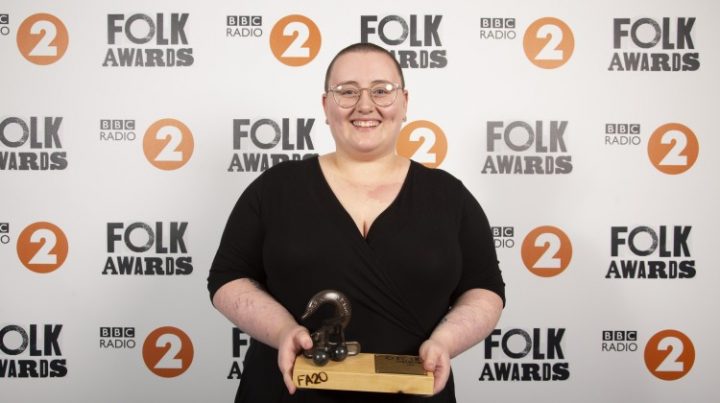
BBC’s Young Folk Award winner, Maddie Morris, finds that they are in fact the political subject: “If you’re gay, and if you’re a woman, in some contexts, your existence is political.” If they were to start their career by writing love songs about boys, like a Taylor Swift pop serenade, they would never have been told they were a political artist.
Image of Maddie Morris | Provided by Maddie Morris
They decided to use their music with the specific intention of talking about power structures and politics, “everyone is seeing so many awful human rights violations and atrocities around us and what’s great about music is it has that transparency…folk music is for disturbing the comforted, and comforting the disturbed.”
Music and Politics
Living in the Trump and Brexit era, grime, folk and pop scrutinise political and societal practices. Stormzy, Dave and Kendrick Lamar have topped charts with their political protests from ‘Vossi Bop’ lyrics “F*ck Boris” to Kendrick Lamar’s Black Lives Matter anthem ‘Alright.’
At the height of the UK’s election in December, Grime4Corbyn made a comeback with #Grime4Corbyn 2.0. This was the second wave of the movement which started in 2017 to get more young people to vote. Stormzy and other grime artists and MC’s such as ‘Novelist’ have been the famous faces of the movement. The female artists involved include; protest singer Nadine Shah, Shura, Katy B and Nadia Rose. In most cases, not the first names or even amongst the first five names mentioned when searching for the cause.
#GRIME4CORBYN Graphic | Made by Frankie Barron – click image for more on SLAM blog
Protest music through the decades
Rewind to 1960s and protest music filled the radio stations. Aretha Franklin awed us with ‘Respect,’ Nina Simone bemoaned the escalating Vietnam war, and yet Bob Dylan’s name is likely the one you’ll recognise. The 70s started ‘Second Wave Feminism,’ “I am woman” by Helen Reddy was all about positive self-image thanks to the women’s liberation movement. Yet it’s the male artists that own protest music in this decade.
Despite this, Maddie Morris believes second wave feminism to be a turning point in protest music, and one that changed the narrative of our generation’s activism. Today’s audience “respond well to these personal narratives because…we’re taking ourselves and we’re using our narratives to show people that actually we are people and we’re not just this political idea.”
Music for Therapy
Most people may go to a therapist or some support group to deal with their problems, but these women create their own therapy. What better way is there to create social change and challenge stereotypes?
For example hip hop. This is a genre notorious for its sexualisation of women and yet it is a genre underrepresented by women. RAY BLK refuses to conform, her honest and explicit discography depicts real life experiences of growing up in London with gang crime. Her song ‘Run Run’ shows the life of a young man who can’t escape danger and is constantly running from people after him. Ray had her own experience with gun crime. It is essential to her to highlight injustice in her music.
However, these are not chart topping, internet-breaking songs. When Stormzy roared “F*ck Boris” the people cheered, but you release an album of raw, uncensored storytelling about crime, sexuality and abuse by…what’s her name again?
It could be perhaps, that the audience simply enjoy the popular controversy of male grime artists. And in turn, overlook the women that sing in protest for legitimate therapy. Or maybe it’s a reflection of the music industry still being dominated by men.
Women like these fight for the important things. They are not ‘Snowflakes’ complaining about their problems but giving a voice to those who can’t use theirs. The platform they create with their music connects people in deeply personal ways.